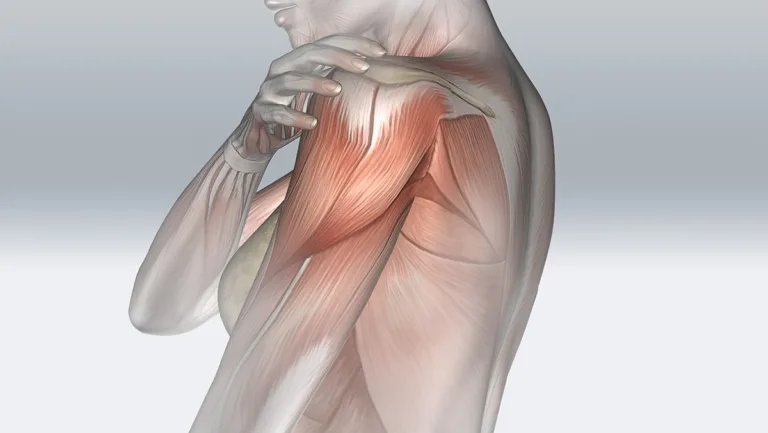
Upper Crossed Syndrome (UCS) is one of the most common postural syndromes affecting office workers, students, and individuals who spend prolonged periods using computers, laptops, or smartphones. As modern lifestyles become increasingly sedentary, poor posture has become a major contributor to musculoskeletal pain and dysfunction.
Over time, prolonged poor posture can lead to a predictable pattern of muscle imbalance that contributes to chronic neck pain, shoulder discomfort, headaches, reduced mobility, and impaired functional movement. If left untreated, these muscle imbalances may progressively alter postural alignment and place excessive stress on the cervical spine and shoulder complex.
Early assessment and physiotherapy intervention can help restore muscle balance, improve posture, relieve pain, and prevent long-term complications.
What Is Upper Crossed Syndrome?
Upper Crossed Syndrome (UCS) is a postural syndrome characterized by a predictable pattern of muscle imbalance involving the neck, shoulders, chest, and upper back. The condition develops when certain muscle groups become overactive and shortened, while their opposing muscles become lengthened, weak, and inhibited, creating the characteristic “crossed” pattern first described by Dr. Vladimir Janda.
These muscle imbalances disrupt normal movement patterns and postural control. As shortened muscles continuously pull the body out of its optimal alignment, the weakened stabilizing muscles are unable to maintain proper cervical and scapular alignment. Over time, this imbalance may contribute to pain, reduced mobility, impaired function, and decreased movement efficiency.
Common Postural Changes in Upper Crossed Syndrome
Individuals with Upper Crossed Syndrome commonly present with the following postural changes:
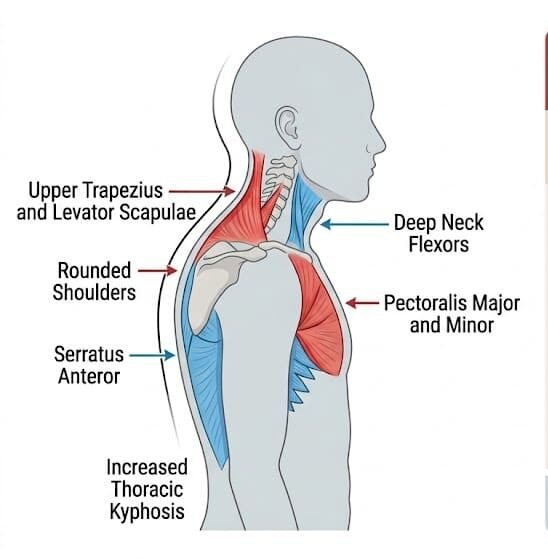
- Forward Head Posture (FHP): The head protrudes forward relative to the shoulders.
- Rounded Shoulders: The shoulders roll forward due to shortening of the chest muscles.
- Increased Thoracic Kyphosis: Excessive rounding of the upper back.
These postural adaptations reduce biomechanical efficiency and increase stress on the muscles, ligaments, and joints of the cervical spine and shoulder complex.

Muscle Imbalances in Upper Crossed Syndrome
The hallmark of Upper Crossed Syndrome is a predictable pattern of muscle imbalance involving shortened, overactive muscles and lengthened, weak, and inhibited muscles.
Shortened (Overactive) Muscles
The following muscles commonly become shortened and overactive:
- Upper Trapezius
- Levator Scapulae
- Pectoralis Major
- Pectoralis Minor
- Sternocleidomastoid (SCM)
These muscles contribute to forward head posture and rounded shoulders by pulling the head and shoulders out of their optimal alignment.
Lengthened (Weak and Inhibited) Muscles
The opposing stabilizing muscles gradually become lengthened, weak, and inhibited as a result of prolonged postural dysfunction.
Commonly affected muscles include:
- Deep Neck Flexors
- Middle Trapezius
- Lower Trapezius
- Rhomboids
- Serratus Anterior
As these stabilizing muscles weaken, they become less effective at maintaining proper cervical and scapular alignment, allowing postural dysfunction to become progressively more pronounced.
What Causes Upper Crossed Syndrome?
Upper Crossed Syndrome usually develops gradually because of repetitive daily habits and prolonged poor posture.
Common contributing factors include:
- Prolonged computer or laptop use
- Prolonged smartphone use (“text neck”)
- Poor sitting posture
- Rounded shoulders while working
- Lack of exercises that strengthen the upper back and postural muscles
- Poor workstation ergonomics
- A sedentary lifestyle
Over time, these habits place continuous stress on the muscles of the neck, shoulders, and upper back, eventually leading to muscle imbalance and postural dysfunction.
Symptoms of Upper Crossed Syndrome
Symptoms often develop gradually and may worsen over time if left untreated.
Common symptoms include:
- Chronic neck pain
- Shoulder pain
- Upper back pain
- Muscle tightness in the neck and shoulders
- Headaches, particularly cervicogenic headaches originating from the upper cervical spine
- Pain or stiffness between the shoulder blades
- Reduced neck mobility
- Difficulty turning the head
- Shoulder stiffness
- Scapular dyskinesis (abnormal movement of the shoulder blade)
- Muscle fatigue after prolonged sitting or desk work
How Is Upper Crossed Syndrome Diagnosed?
A comprehensive physiotherapy assessment is essential for identifying the underlying muscle imbalance contributing to Upper Crossed Syndrome.
The assessment typically includes:
Postural Assessment
The physiotherapist evaluates:
- Head position
- Shoulder alignment
- Thoracic spine curvature
- Scapular alignment
- Scapular winging
- Overall spinal alignment
Muscle Length Testing
Muscle length testing is performed to assess shortening of the following muscles:
- Upper Trapezius
- Levator Scapulae
- Pectoralis Major
- Pectoralis Minor
- Sternocleidomastoid
Muscle Strength Testing
Muscle strength testing evaluates the activation, strength, and endurance of:
- Deep Neck Flexors
- Middle Trapezius
- Lower Trapezius
- Rhomboids
- Serratus Anterior
The physiotherapist may also assess functional movement patterns to identify abnormal muscle recruitment and impaired postural control.
Physiotherapy Treatment for Upper Crossed Syndrome
The primary goals of physiotherapy are to relieve pain, restore muscle balance, improve postural alignment, optimize movement, and prevent recurrence.
Treatment should always be individualized according to each patient’s clinical presentation, functional limitations, and rehabilitation goals.
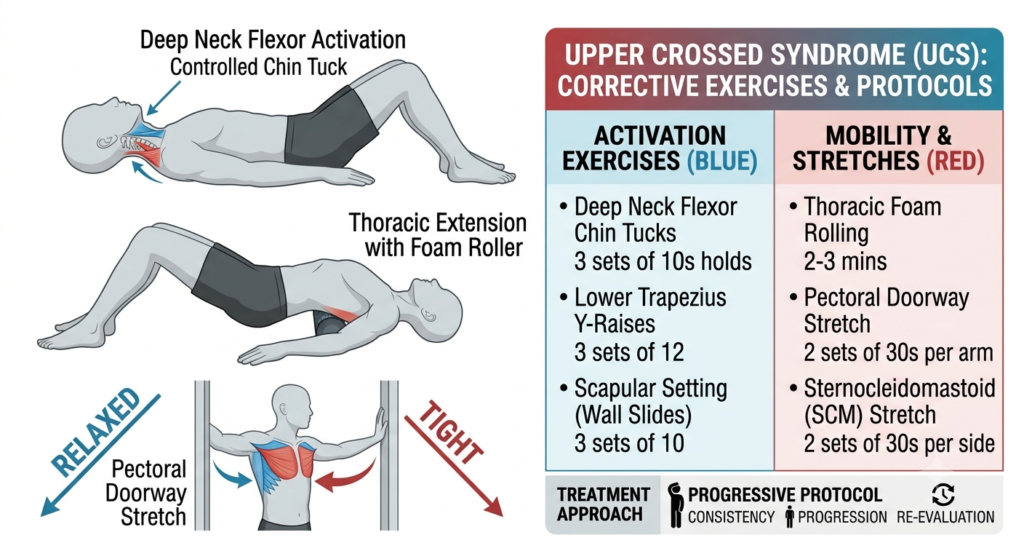
1. Stretch Shortened Muscles
Stretching helps restore normal muscle length, reduce excessive muscle tension, and improve flexibility.
Common stretches include:
- Upper Trapezius Stretch
- Levator Scapulae Stretch
- Doorway Pectoral Stretch
- Sternocleidomastoid Stretch
Regular stretching can reduce muscle tightness and improve cervical and shoulder mobility.
2. Strengthen Lengthened and Inhibited Muscles
Strengthening exercises focus on restoring the function of the postural muscles responsible for maintaining proper head, neck, and shoulder alignment.
Common rehabilitation exercises include:
Chin Tucks
Strengthen the deep neck flexor muscles and improve cervical alignment.
Scapular Retraction
Activates the middle trapezius and rhomboids while improving scapular stability.
Wall Angels
Improve thoracic mobility, shoulder mobility, and scapular control.
Prone Y and T Exercises
Strengthen the lower trapezius, middle trapezius, and posterior shoulder stabilizers while improving scapular control and postural stability.
Exercise programs should always be individualized according to the patient’s symptoms, functional limitations, and rehabilitation goals.
3. Postural Correction and Ergonomic Education
Long-term improvement depends not only on exercise but also on correcting daily postural habits and optimizing workstation ergonomics.
Patients are encouraged to:
- Position the computer monitor at eye level.
- Maintain a neutral sitting posture with relaxed shoulders.
- Keep the elbows at approximately 90 degrees while working.
- Use a supportive chair with appropriate lumbar support.
- Take movement breaks every 30 to 60 minutes.
- Avoid prolonged smartphone use with the neck flexed forward.
Small ergonomic adjustments can significantly reduce stress on the cervical spine and help prevent symptom recurrence.
What Happens If Upper Crossed Syndrome Is Left Untreated?
Without appropriate treatment, Upper Crossed Syndrome may lead to chronic pain, progressive postural dysfunction, and reduced functional capacity.
Potential complications include:
- Chronic neck pain
- Cervicogenic headaches
- Shoulder impingement syndrome
- Reduced shoulder mobility
- Accelerated degenerative changes of the cervical spine
- Recurrent muscle strain
- Reduced upper-limb function
- Decreased quality of life
Early physiotherapy intervention can significantly reduce the risk of these long-term complications.
Can Upper Crossed Syndrome Be Prevented?
Many cases of Upper Crossed Syndrome can be prevented by maintaining good posture, exercising regularly, and optimizing workplace ergonomics.
Helpful preventive strategies include:
- Maintain proper sitting and standing posture.
- Perform regular stretching and strengthening exercises.
- Strengthen the upper back and deep neck muscles.
- Optimize workstation ergonomics.
- Limit prolonged smartphone use.
- Stay physically active.
- Take regular movement breaks during prolonged sitting.
Consistently following these habits can help maintain healthy postural alignment and reduce the risk of developing Upper Crossed Syndrome.
When Should You See a Physiotherapist?
You should consult a physiotherapist if you experience any of the following:
- Neck or shoulder pain lasting more than a few weeks
- Frequent headaches associated with neck stiffness
- Difficulty turning your head
- Noticeable forward head posture or rounded shoulders
- Pain that worsens after prolonged computer or smartphone use
- Recurring symptoms despite self-management
A physiotherapist can identify the underlying muscle imbalance contributing to your symptoms and develop a personalized rehabilitation program to restore postural alignment, improve movement, relieve pain, and reduce the likelihood of recurrence.
Key Takeaways
Upper Crossed Syndrome is a common postural syndrome caused by a predictable pattern of muscle imbalance affecting the neck, shoulders, chest, and upper back. It is particularly common among office workers and individuals who spend prolonged periods using computers or smartphones.
Although the condition develops gradually, it is highly responsive to early physiotherapy intervention. A comprehensive rehabilitation program that combines targeted stretching, strengthening exercises, postural retraining, and ergonomic modifications can effectively relieve pain, restore normal movement, improve postural alignment, and reduce the risk of recurrence.
Recognizing the early signs of Upper Crossed Syndrome and seeking timely physiotherapy care can help prevent chronic pain, improve function, and support long-term musculoskeletal health.
Contact US 👇
🌐 Offical Website : www.greenbellclinic.com
📌 IG : @greenbell_clinic
🟩 LINE Offical : @greenbell
⬛ TIKTOK : greenbellmedicalclinic
🟥 Youtube : Greenbell Medical Clinic